Introduction: The Echoes of Tragedy
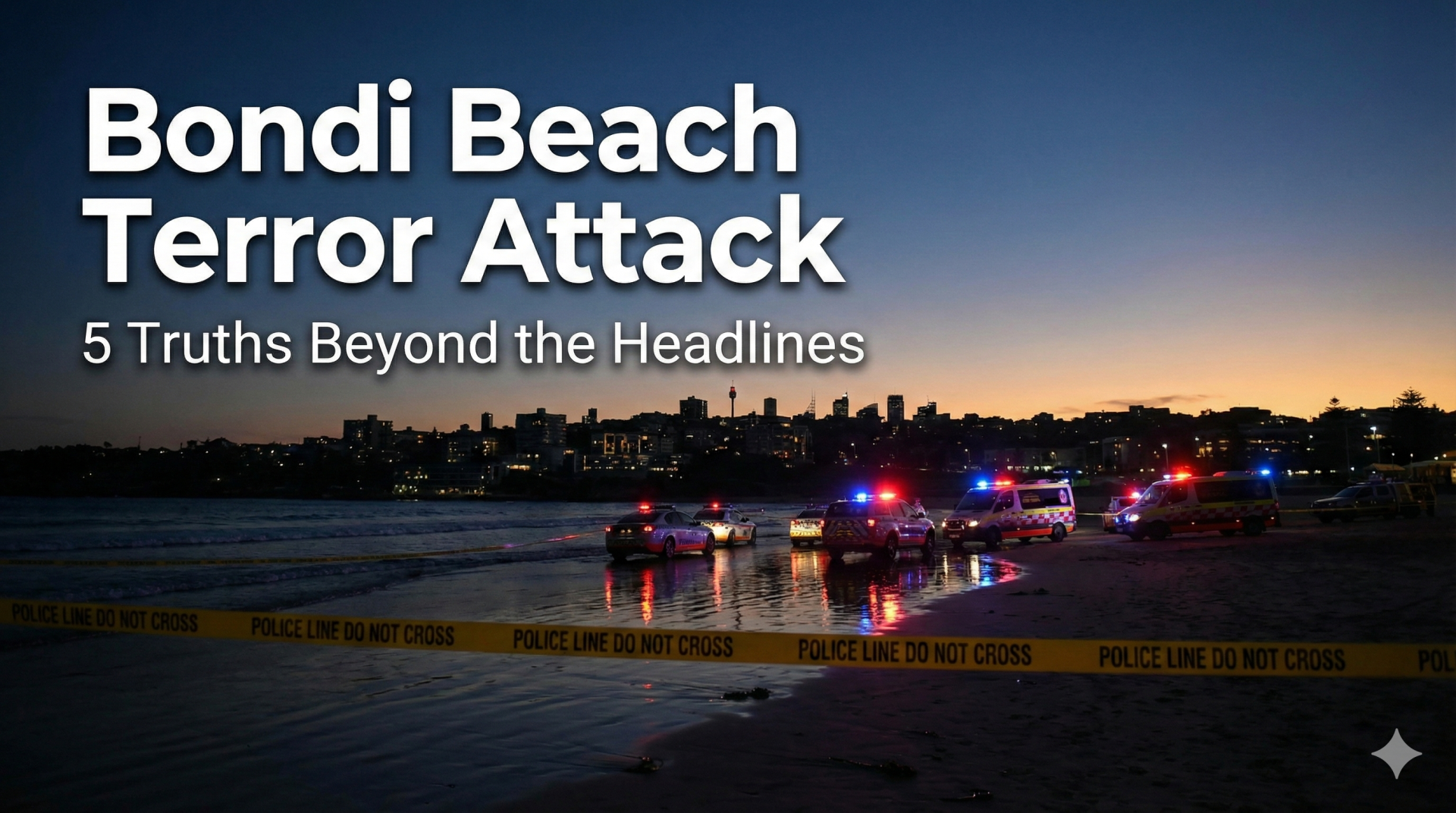
The horrific terror attack at Bondi Beach on December 14, 2025, which left 16 people dead (including one gunman) and 43 injured, sent a shockwave of grief and disbelief across Australia and the world. In the aftermath of such profound violence, the immediate focus is rightly on the victims, their families, and the raw pain of the community. Yet, as the initial horror subsides, a deeper understanding of the event is not only possible but essential to collective resilience.
This article moves beyond the headlines to examine the unseen truths this tragedy reveals about Australian society, national security, and civic responsibility. The Bondi area has now endured two distinct mass-casualty events in less than two years: the Westfield stabbings of April 2024, an act of pathological violence, and the 2025 terror attack, a deliberate act of ideological hatred. Understanding the crucial differences between these attacks is the first step toward making sense of the violence—and the systemic vulnerabilities each exposed.
By examining the context, failures, methods, heroism, and consequences of the Bondi Beach attack, we can identify five critical takeaways that offer a more grounded and necessary perspective on this defining moment in Australian history.
1. The Attack Was a Symptom, Not a Standalone Event
To comprehend the Bondi Beach attack, a difficult truth must be acknowledged: it did not occur in a vacuum. Major acts of ideological violence are rarely spontaneous. They are typically the culmination of long-simmering social fractures and security failures.
The events of December 14 were foreshadowed by a series of escalating warning signs that, when viewed together, form a clear causal chain:
A national rise in antisemitism: Since October 2023, Australia had seen a documented increase in attacks against Jewish communities, creating a climate of fear and vulnerability.
An elevated national threat level: In August 2024, ASIO raised the national terrorism threat level from possible to probable, citing political violence and community tensions linked to the war in Gaza.
Localized warnings: In the weeks preceding the attack, antisemitic graffiti appeared across North Bondi—an explicit local manifestation of the hatred that would soon turn lethal.
This context dismantles any narrative that the attack was unpredictable or isolated. Instead, it illustrates a direct progression from ideological vitriol to organized violence. As one community leader warned, the trajectory was both familiar and ignored:
“We have warned for years that the unceasing antisemitic vitriol on our streets would evolve into antisemitic violence if left unchecked. We have warned that verbal abuse becomes graffiti, becomes arson, becomes physical violence, becomes murder.”
— Colin Rubenstein, Executive Director, Australia/Israel & Jewish Affairs Council
Unchecked public hatred provided the ideological fuel, while an elevated threat level confirmed the danger—creating a permissive environment for catastrophic failure.
2. A Known Threat Slipped Through the Cracks

Public discourse after terror attacks often focuses on ideology. Equally important, however, is scrutiny of the systems designed to prevent such events. One of the most sobering truths of the Bondi Beach attack is that security agencies had prior knowledge of one perpetrator—yet failed to intervene.
The younger assailant, 24-year-old Naveed Akram, had been known to ASIO since 2019 but was assessed as “not an immediate threat.” The dissonance between that assessment and the outcome exposes a critical weakness in counter-terrorism prioritization.
Australia now faces a dual challenge. Security systems must anticipate:
Ideological radicalization, as seen in the 2025 terror attack.
Pathological violence, as seen in the 2024 Westfield stabbings.
These are fundamentally different threats, yet both can produce mass casualties. ASIO Director-General Mike Burgess has repeatedly warned that modern terrorism increasingly takes the form of small-scale, rapidly mobilized individuals or micro-networks. The Bondi Beach attack demonstrates how dangerously short the gap can be between intelligence assessment and mass violence.
3. The Attackers’ Methods Revealed a Terrifying Level of Planning
The tactics used in an attack reveal the perpetrators’ intent. The Bondi Beach shooting was not an impulsive act—it was a deliberately engineered operation designed for maximum lethality.
Key elements of the attackers’ methods included:
Coordinated assailants: A father and son working together, firing from an elevated footbridge to target crowds below.
High-powered firearms: Including at least one bolt-action rifle, enabling sustained and accurate fire.
Attempted secondary attacks: NSW Police later discovered suspected homemade bombs and improvised explosive devices (IEDs) in a vehicle linked to one shooter.
The presence of IEDs is especially chilling. Vehicle-based explosives are a hallmark of international terror tactics, often intended to target first responders after the initial attack. Their discovery indicates intent to cause casualties on a far larger scale than ultimately occurred.
The result was the deadliest terror incident in Australian history and the second-deadliest mass shooting since Port Arthur in 1996. The level of planning underscores both the severity of the threat and the cost of intelligence failure.
4. Civilian Heroism Is Powerful—but Incomplete—Protection
In the earliest moments of public attacks, outcomes are often shaped not by policy but by people. As in 2024, the 2025 attack revealed extraordinary civilian courage, alongside a troubling reliance on chance.
During the shooting, an unarmed bystander tackled one of the gunmen from behind, wrestled away his weapon, and turned it on the attacker. He was shot twice in the process. His intervention almost certainly saved lives.
Prime Minister Anthony Albanese acknowledged the act plainly:
“These Australians are heroes. And their bravery has saved lives.”
— Prime Minister Anthony Albanese
The moment echoed the 2024 Bondi Junction stabbings, where Damien Guerot used a bollard to confront a knife-wielding attacker. In both cases, lives were saved by individuals acting on instinct—not training.
This pattern exposes a systemic issue: reliance on luck. A resilient security posture cannot depend on the presence of an exceptionally brave bystander. It must include formal active-bystander training, public readiness education, and integrated emergency response frameworks. Heroism is invaluable—but it should be supported, not assumed.
5. The Tragedy Reignited a National Reckoning on Gun Control
Australia’s post–Port Arthur gun reforms have long been considered world-leading. The Bondi Beach terror attack shattered any remaining complacency and forced the first serious national re-evaluation of firearm laws in decades.
Prime Minister Albanese convened the National Cabinet and proposed significant tightening of existing regulations. Key measures under consideration include:
Restricting firearm ownership to Australian citizens only.
Accelerating a national firearms register for unified oversight.
Limiting the number of firearms an individual may own.
Ending “in perpetuity” licenses in favor of ongoing suitability audits.
These reforms represent a strategic pivot. Intelligence cannot always identify radicalization in time. When prevention fails upstream, controlling access to weapons of mass harm becomes the most reliable safeguard. The proposals aim to close the gaps that allowed a licensed owner to participate in a sophisticated terror plot.
What This Moment Demands
The Bondi Beach terror attack was not a singular rupture but the outcome of converging pressures: rising ideological hatred, intelligence blind spots, tactical sophistication, and systemic overreliance on chance heroism. It was met with courage—but also with overdue policy reckoning.
The paired tragedies of 2024 and 2025 in the same community reveal a hard truth. Australia now faces two parallel threats: organized ideological terrorism and unpredictable pathological violence. One demands robust national security; the other requires effective mental health intervention. Both require an informed, engaged public.
The question this moment leaves behind is not abstract. It is practical and urgent: how must government, institutions, and citizens recalibrate shared responsibility to build a society that is not only secure, but resilient to threats from both without and within?